
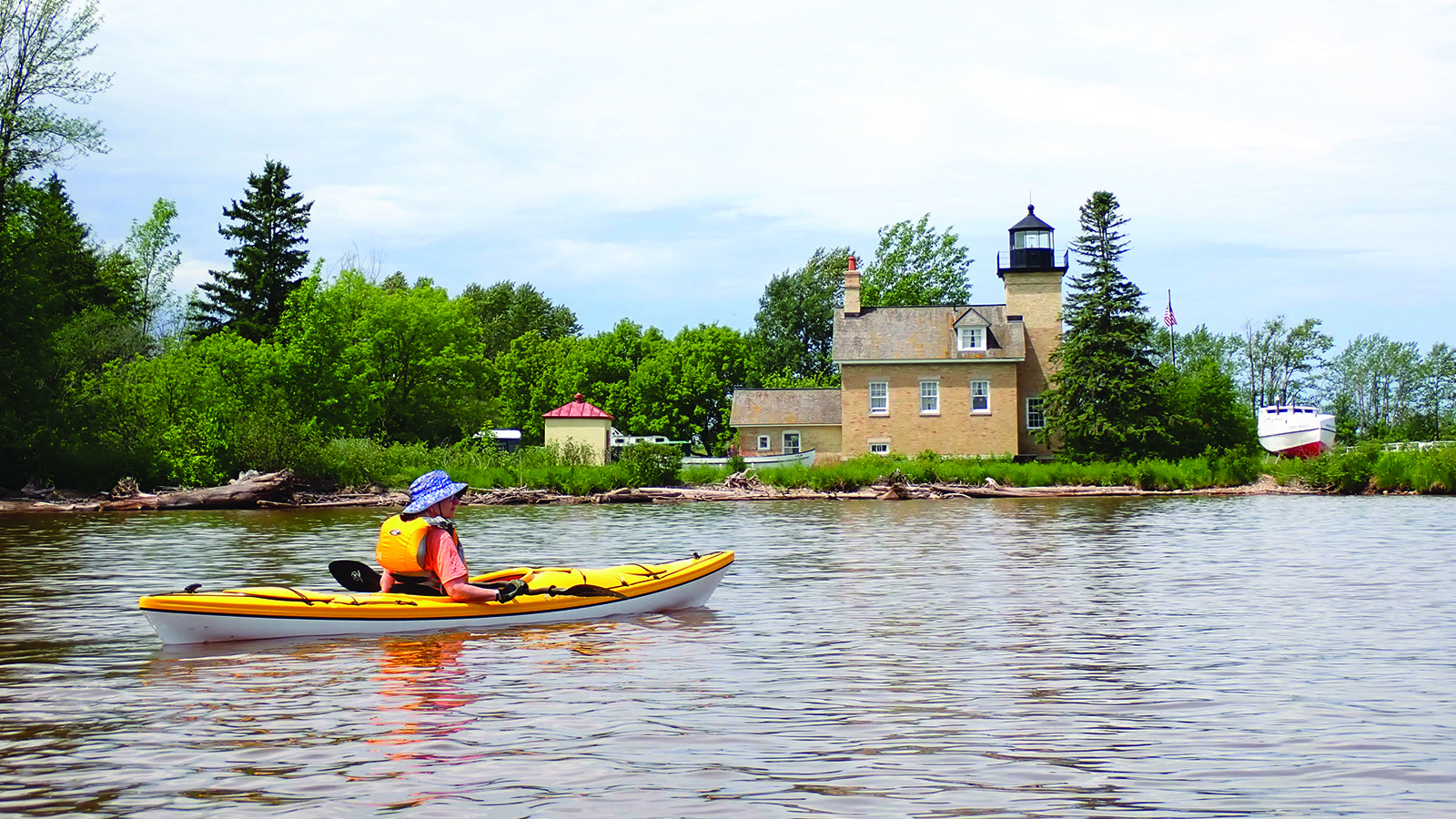
Whether you’ve lived in Ontonagon all your life or you recently moved to “Harbor Town,” you’re likely familiar with the area’s various landmarks. Bond Falls. Lake of the Clouds. Old Victoria.
A Step Back in Time
Aside from the Porcupine Mountains, no other landmark stands out more than the Ontonagon Harbor Lighthouse though. After all, it’s one of the area’s most historic attractions. In fact, this year it’s celebrating its 160th anniversary.
Interestingly, the current brick lighthouse isn’t even Ontonagon’s first. As further evidence of the town’s longstanding association with lighthouses, another one was built in 1853.
Made entirely of wood, the original lighthouse unfortunately rotted, due to its location on the Ontonagon River’s floodplain.
“The U.S. Lighthouse Service built both of the lighthouses,” said Dean Juntunen, president of the Ontonagon County Historical Society. “After the brick house went into service, the wooden structure was completely removed.”
When compared to some of Michigan’s 129 historic lighthouses, the Ontonagon Harbor Lighthouse has remained relatively unchanged since it first opened in 1866. In particular, its brick structure and tower look much like it did back then.
However, if a lightkeeper from the 1860s were to visit the lighthouse today, they would notice some significant changes, too. First, a summer kitchen was created in 1890, while its basement was also finished during that same time period. Not to mention, dormers were added to the lighthouse’s living quarters in 1904.
In addition to these key changes, the lighthouse became known for its fifth order Fresnel lens. This lens was originally installed in the wooden lighthouse in 1857 and transferred in 1866. Unlike the mirrored Winslow Lewis lens (which the wooden lighthouse had in 1853), the Fresnel lens offered a focal plane at 39 feet above lake level. As a result, it could be seen from up to 13 miles offshore.
“The U.S. Lighthouse Service also moved to kerosene around the 1870s,” Juntunen added. “Kerosene is more efficient than vegetable oil in lamps, but it couldn’t be stored in living quarters. Thus, an oil house was added outside of the lighthouse as well.”
A Continuous Rise in Popularity
Over the years, the Ontonagon Harbor Lighthouse has become more and more popular, as tourists continue to discover it. As an example of its enduring reputation as a must-visit attraction, 3,000 to 4,000 people tour it annually.
While reflecting on its ongoing popularity, Juntunen believes there are several reasons why people from all over the world visit it. Above all else, it provides a connection to history— a visual representation of Michigan’s and Ontonagon’s early years.
Restored to roughly 1915, the lighthouse features an assortment of artifacts and furniture from that bygone era, which visitors simply love to look at, often for hours at a time. According to Juntunen, this restoration ensures the lighthouse isn’t just an “empty structure.” Rather, it feels as if “someone is still living there.”
“Tourists get a good taste of life in the U.S. Lighthouse Service,” Juntunen emphasized. “And people just love lighthouses. Ours sees about twice as many visitors as our museum.”
Along with its restoration (via a State Historic Preservation Office grant), the Ontonagon Harbor Lighthouse stands out for its location, too. It’s a quarter of a mile inland from Lake Superior’s shoreline.
There are two key causes for this. First, long piers were installed many years ago. Second, sediments were deposited on the upstream side of the lighthouse’s west pier— a direct result of Lake Superior’s Keweenaw Current. This remained the case until a new balance point was reached by the shoreline, leading to the lighthouse’s present location.
“This inland position makes our lighthouse unique,” Juntunen said.
Finally, the lighthouse provides visitors another opportunity to live in the 1860s. Its outhouse is original as well, as it features the same Milwaukee Cream City bricks that the lighthouse does.
“It was also restored onsite,” Juntunen added. “It’s stood the test of time, too.”
Looking Ahead
As the Ontonagon Harbor Lighthouse celebrates its 160th anniversary this year, it will continue to be overseen by a dedicated group of volunteers. Thanks to these individuals, it will be open to the public seven days a week—from 11 a.m. to 3 p.m. ET—until mid-October.
“This summer, we also replaced two aging windows,” Juntunen said. “In the next year or two, we’re hoping to find a grant to replace the remaining eight windows as well.”
Finally, Juntunen is hoping that tourism thrives throughout the coming months, enabling him and the volunteers to share their stories of the lighthouse and Ontonagon as a whole.
“We’d like to see over 4,000 visitors this year,” Juntunen concluded.